Stand close to a brick mosaic and you see a collection of colored pieces. Step back and a face, a landscape or a butterfly appears. That shift between material and image is the medium’s central pleasure.
Brick mosaic art has developed along several paths: personal commissions, independent artistic experiments, museum installations and boxed building sets. There is no need to invent a single origin story to understand its appeal. A few documented milestones reveal how widely the format can travel.
What makes a brick mosaic a mosaic?
A mosaic forms an image from discrete pieces. In a brick mosaic, those pieces belong to a construction system, often arranged on a regular grid. From a distance, neighboring colors combine perceptually; up close, the surface keeps its visible structure.
This gives the designer two jobs. The picture must read, but the pieces must also work as physical objects. A studded finish catches light differently from a smooth tile. A limited palette changes the way skin tones, shadows and gradients can be described.
Brick sculpture belongs to the same broad material practice, but it is not automatically a mosaic. The distinction matters: a freestanding figure and a flat portrait solve different spatial problems.
2004: a personal commission becomes a starting point
In a 2016 interview with Lewis Ginter Botanical Garden, Brian Korte identifies a wedding portrait made in 2004 as his first mosaic. It is one artist’s starting point, not a claim about the invention of the medium. His account also describes digital planning before physical assembly.
That sequence remains familiar: choose an image with personal meaning, translate it into a buildable pattern, and spend time making it tangible. The digital stage and the hands-on stage can be parts of the same craft.
2014: the portrait grid enters an installation at monumental scale
Ai Weiwei’s Trace was commissioned for an Alcatraz exhibition in 2014. The work’s 176 portraits use more than 1.2 million LEGO bricks. The Hirshhorn’s account of its 2017 presentation explains the work’s political context and the connection between pixelation, information and surveillance.
The grid here does more than simplify faces. Repetition creates a relationship between individual subjects and a collective field, showing how a familiar construction material can carry a complex public argument.
2020: LEGO Art makes the framed mosaic a product format
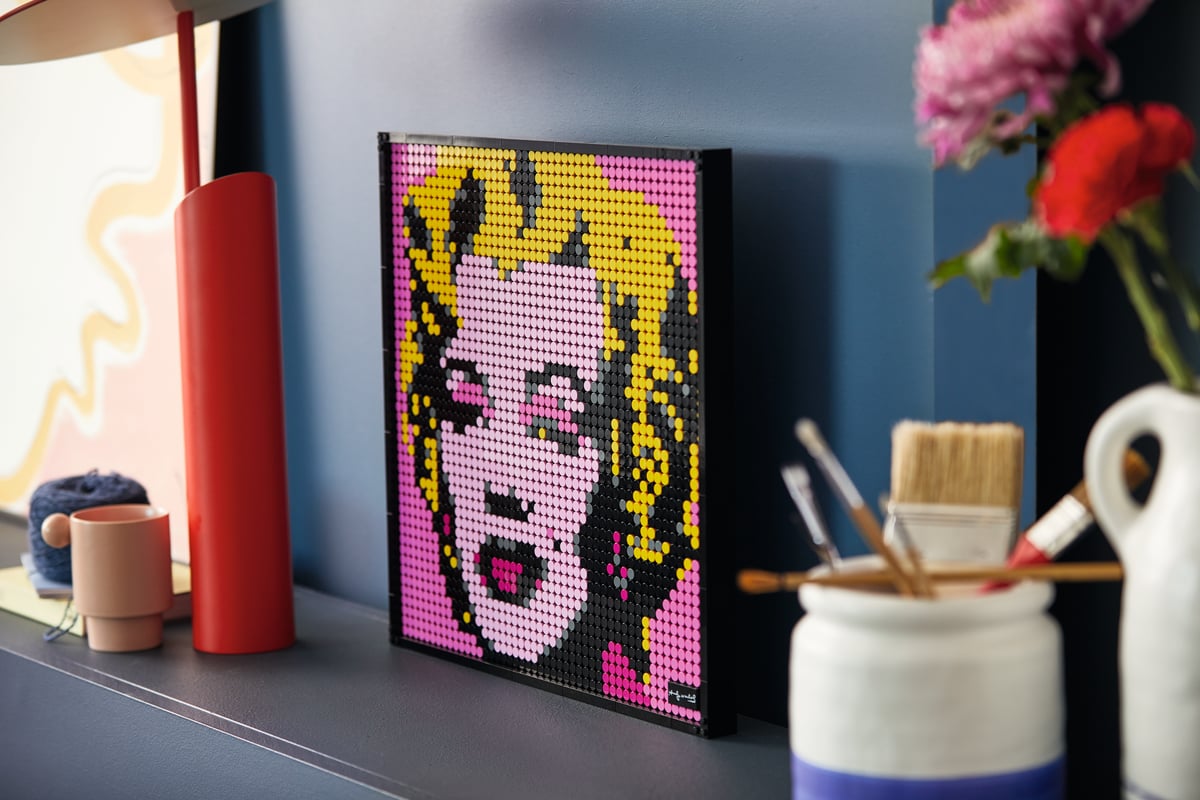
In July 2020, the LEGO Group announced LEGO Art with sets based on Andy Warhol’s Marilyn Monroe, the Beatles, Marvel’s Iron Man and Star Wars’ Sith characters. The launch placed flat, displayable images at the center of the building experience.
A boxed set provides a defined subject, parts and instructions. An original mosaic begins earlier, with the choice of image, crop, palette and composition. Both involve assembly, but they offer different amounts of design freedom.
2021: scale becomes part of the attraction
The LEGO Art World Map, announced in May 2021, contained 11,695 elements. That number describes a specific set, not a requirement for a compelling mosaic. A smaller portrait can succeed with far fewer positions if its subject and crop are well chosen.
More pieces create more room for detail, but they also increase the space, materials and assembly work involved. A useful design question is therefore not “How large can this be?” but “What needs to remain recognizable at the size I can build?”
Digital planning brings the decisions into view
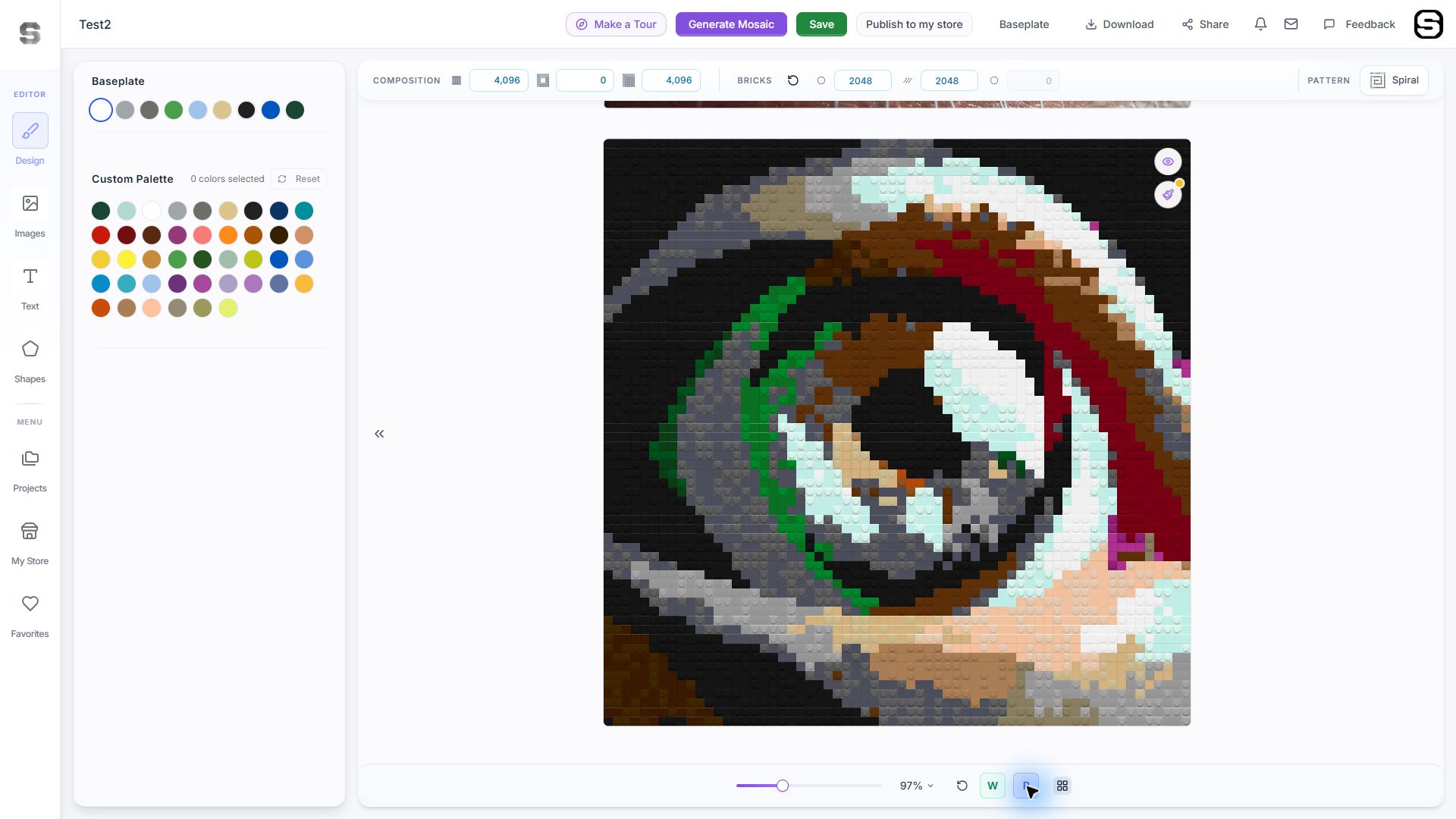
Software lets a designer preview a grid before committing to a physical build. In the Sozaik example above, the eye remains recognizable through the dark pupil, the arc of the iris and the bright reflection. Individual fine lines give way to larger color groups.
The preview makes those tradeoffs visible, but it does not remove judgment. Cropping, choosing which features matter and checking the image from farther away remain design decisions.
Where your own mosaic fits
You do not need a monumental installation or a room full of parts to start exploring the medium. Choose one image, decide what makes it recognizable and build a design around that feature. A pet’s silhouette or a familiar expression is a useful first test.
Try an image in Sozaik Studio, then compare the close view with the view you would see across a room. The interesting moment is when a collection of pieces begins to hold the image together.
Sozaik is independent of the LEGO Group. Historical dates and quantities above refer to the linked announcements and exhibition records.



0 comments
to join the discussion.