
Art history · Six artists · One evolving medium
Stand close to a brick mosaic and you see separate pieces. Step back and a face, a landscape, or a political statement comes into view. That movement between the part and the whole is its central pleasure. The image seems to assemble itself twice: once in the artist’s hands, and again in the viewer’s eye.
Brick mosaic art did not begin with a boxed wall-art set, and its history belongs to more than one celebrated builder. It runs through hobbyist experiments, commissioned portraits, public exhibitions, and contemporary art. Some artists made the medium more visible; others changed what it could say.
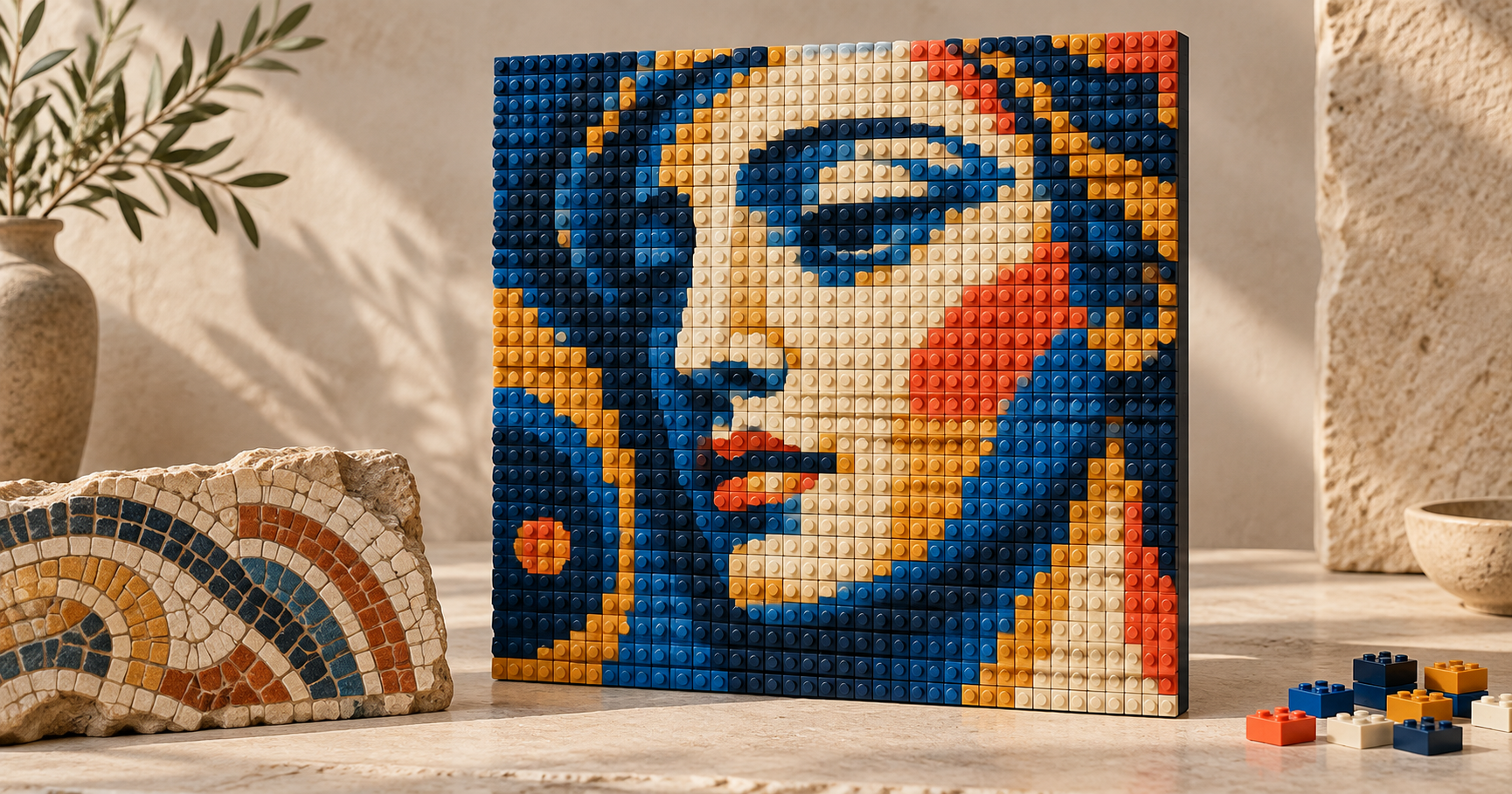
“Brick art” includes sculptures, installations, and mosaics. This story follows images built from separate elements, while acknowledging sculptors who helped bring the wider medium to public attention. It does not claim a single inventor or an exhaustive list of pioneers.
Before the brick: the old idea behind the new image
Long before plastic, mosaic makers assembled images from small pieces of material. Roman artists used tesserae—pieces of stone or glass—to decorate floors and walls. Smaller elements could produce remarkably fine detail. The connection to today’s brick mosaics is a shared visual principle: individual units become a larger image. It is a comparison of methods, rather than proof of an uninterrupted artistic lineage. Explore the Getty’s introduction to Roman mosaics.
The modern interlocking brick supplied a different kind of unit. LEGO dates the patent application for its stud-and-tube coupling system to 28 January 1958. That milestone concerns the construction system, not the invention of brick mosaic art. A reusable, modular material could eventually serve as both structure and visible mark. LEGO’s history of the coupling system.
A brief timeline
1958 — Patent application for the modern stud-and-tube system.
2000 — Eric Harshbarger’s large Mona Lisa mosaic attracts online attention.
2004 — Brian Korte makes a wedding-gift mosaic, a starting point for his practice.
2007 — Nathan Sawaya’s The Art of the Brick begins its exhibition journey.
2014 — Ai Weiwei’s Trace brings brick portraits to Alcatraz.
2020 — LEGO announces the LEGO Art range.
2023 — Ai Weiwei’s Water Lilies #1, made in 2022, is exhibited at the Design Museum.
2025 — LEGO House selects Gerardo Pontierr for its Masterpiece Gallery.
1. Eric Harshbarger: a familiar masterpiece, a new material
In September 2000, Wired profiled Alabama programmer and LEGO builder Eric Harshbarger, who was working on a commissioned Mona Lisa roughly ten feet tall and seven feet wide. A later community report carried his announcement that it was finished. This is a documented early landmark—not evidence that no one had made a brick mosaic before him. Read the contemporary Wired report and the completion update.
Choosing such a recognizable painting made the transformation easy to understand. Viewers could compare an image they already knew with its new, visibly assembled surface. For a builder, the interesting question is less “Can every detail survive?” than “Which few relationships make the subject recognizable?” A mosaic becomes an interpretation, even when its starting point is famous.
2. Sean Kenney: bringing the medium into everyday view
Sean Kenney represents another route to visibility: a sustained practice spanning portraiture, sculpture, and public art. A 2009 interview describes his move into full-time LEGO work in 2003; his own biography records his years as a LEGO Certified Professional from 2005 to 2019. Read the early interview and Kenney’s artist biography.
His portraits belong directly to the mosaic story, while his larger sculptures and nature-themed exhibitions show how broadly the same material can communicate. These are related strands of one practice, not interchangeable techniques. A portrait asks us to recognize an individual through selected colors and shapes; a public sculpture also works through silhouette, volume, and its surroundings. Kenney’s career makes that range visible beyond the specialist building community.
3. Brian Korte: from a wedding gift to a portrait practice
For Brian Korte, the starting point was personal. In an interview with Lewis Ginter Botanical Garden, he recalled making his first mosaic in 2004 as a wedding gift. His process drew on cross-stitch: an image could be planned on a grid and translated into discrete colored units. His practice developed into Brickworkz and later included botanical imagery exhibited at the garden. Read the garden’s interview with Korte.
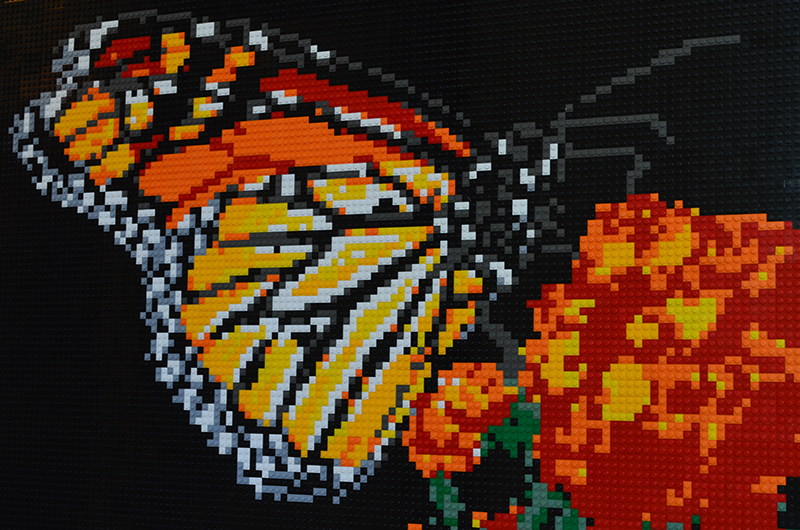
This is a useful counterpoint to the monumental masterpiece. Mosaic art can begin with something close to home: a gift, a person, a garden. Korte’s account also makes the preparation visible. Behind the finished image sits a sequence of decisions about the grid, the available colors, and how a continuous photograph should become a finite collection of parts. The computer can assist, but the choices still shape the result.
4. Nathan Sawaya: opening the gallery door for brick art
Nathan Sawaya belongs in this history because of the audience he helped build for the broader medium. His official biography dates the premiere of The Art of the Brick to 2007. The touring exhibition made brick-based work the subject of a dedicated art encounter. Explore Sawaya’s official artist site.
His best-known practice is strongly associated with sculpture, so presenting him as the inventor of brick mosaics would blur an important distinction. His relevance here is cultural: an exhibition centered on this familiar construction material invites visitors to consider form, emotion, and authorship. That wider conversation creates a setting in which a brick portrait can also be approached as an artistic decision, rather than simply a feat of patience.
5. Ai Weiwei: the portrait becomes a public statement
With Ai Weiwei, the significance of the material shifts. Trace, commissioned for the 2014 exhibition @Large on Alcatraz, consists of 176 portraits assembled from more than 1.2 million LEGO bricks. The people represented came from more than 30 countries and had been identified by Ai and human rights organizations as activists, prisoners of conscience, or advocates of free speech. The Hirshhorn later exhibited the work in Washington. Read the Hirshhorn’s account of Trace.
Here, recognition carries a different responsibility. The viewer is looking at individuals within a much larger field of faces. Repetition gives the work a common visual language without making the lives it represents identical. A familiar, playful material becomes a way to ask who is remembered, who is seen, and who gets to speak.
Watch: Trace at the Hirshhorn
Official museum video, linked from the Hirshhorn exhibition page. Watch on YouTube.
A different dialogue with art history appears in Water Lilies #1. Made in 2022 and shown in the Design Museum’s Making Sense exhibition in 2023, it reworks Monet’s water-lily imagery using LEGO elements. A dark doorway interrupts the scene, referring to the underground dwelling in Xinjiang where Ai and his father lived in exile. The landscape becomes a meeting point between a canonical painting and personal memory. See the Design Museum’s account; consult the exhibition guide for the artwork date.

2020: a wider invitation to make wall art
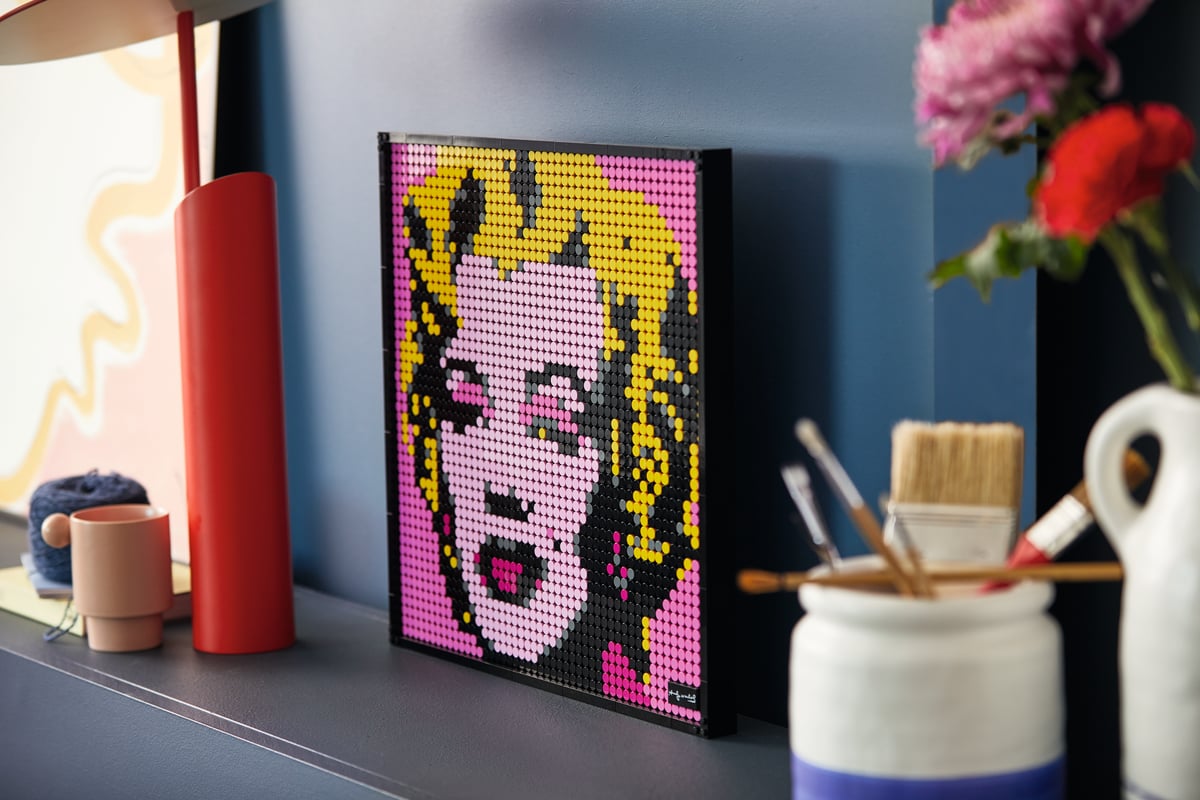
Between those two Ai Weiwei projects came a commercial milestone. In July 2020, LEGO announced LEGO Art, with initial sets featuring Andy Warhol’s Marilyn Monroe, the Beatles, Marvel’s Iron Man, and Star Wars’ Sith characters. The range packaged mosaic-style wall art as an adult building activity. Read the original LEGO Art announcement.
The date matters because it marks an expansion of the invitation, not the birth of the practice. Artists and independent builders had already been exploring the medium for years. A prepared kit offers a subject, a palette, and a sequence; an original mosaic asks the maker to decide those things. Both involve assembly, but they distribute the creative decisions differently.
6. Gerardo Pontierr: taking the image beyond a flat grid
Gerardo Pontierr, the artist name of Mexican musician Gerardo Ponce Gutierrez, offers a more recent direction. In his LEGO House profile, he describes beginning to explore three-dimensional mosaics in 2020. Selected for the 2025 Masterpiece Gallery, he combines images with depth, changing viewing angles, and details that invite closer inspection. Read the LEGO House artist interview.

His La Catrina, described in the same interview, uses around 17,000 pieces and pays tribute to Mexican culture. The broader lesson is that a mosaic need not behave like a flat print. Raised elements can introduce shadow and make the viewer’s position part of the experience. Color remains essential, but the surface itself becomes another way to draw.
Three things to look for in any brick mosaic
01 · Distance
Move closer, then step back. When do separate parts become an image? Which details disappear, and which remain?
02 · Color
Look at the large light and dark areas before individual shades. What holds the composition together when you narrow your eyes?
03 · Surface
Notice studs, smooth tiles, and raised forms. Does texture stay in the background, or become part of the subject?
These questions also help when making your own work. Start with an image you care about, decide what must remain recognizable, and treat simplification as a creative choice. A convincing portrait does not necessarily require the largest possible grid. It requires choices that make sense together.
The artists in this story made different choices: familiar masterpieces, personal commissions, public encounters, political remembrance, and relief surfaces. Their careers are not a single chain of influence. Read together, they show how much expression can fit inside a material often associated with following instructions.
What would you turn into a mosaic?
Bring that question to your next design. Explore a composition in Sozaik Studio, study what survives at a smaller scale, and make the palette part of the idea.
Explore Sozaik Studio →Sources & further looking
This article draws on museum interpretation, artist accounts, original announcements, and contemporary reporting. The timeline is selective. Links beside each section lead to the evidence for its dates and works; the connections between the artists are an editorial reading, not claims of direct influence.
- Getty — A Brief Introduction to Roman Mosaics
- LEGO History — The stud-and-tube principle
- Wired — The Michelangelo of Lego (2000); Slashdot — completion report (2000)
- Sean Kenney — artist biography; Time Out interview reproduced by the artist (2009)
- Lewis Ginter Botanical Garden — Brian Korte interview (2016)
- Nathan Sawaya — official artist site
- Hirshhorn — Ai Weiwei: Trace
- Design Museum — Making Sense highlights; large-print exhibition guide
- LEGO — original LEGO Art announcement (2020)
- LEGO House — Gerardo Pontierr, Masterpiece Gallery 2025
Historical photographs are credited individually. The cover is an AI-generated editorial illustration. LEGO is a trademark of the LEGO Group; this independent article is not sponsored or endorsed by the LEGO Group.


0 comments
to join the discussion.